
Section 5.3 The Mean Value Theorem

The derivative is defined pointwise, but the next results show that it controls the global behavior of a function on an interval. Rolle’s theorem and the Mean Value Theorem connect endpoint information with the derivative at some interior point. They are among the central tools of differential calculus.

Subsection 5.3.1 Critical Points and Rolle’s Theorem

Proof.

Suppose \(f\) has a local maximum at \(c\text{.}\) Then for all \(x\) sufficiently close to \(c\text{,}\) we have \(f(x)-f(c) \le 0\text{.}\) If \(x \lt c\text{,}\) then \(x-c \lt 0\text{,}\) so
\begin{equation*} \frac{f(x)-f(c)}{x-c} \ge 0. \end{equation*}
If \(x \gt c\text{,}\) then \(x-c \gt 0\text{,}\) so
\begin{equation*} \frac{f(x)-f(c)}{x-c} \le 0. \end{equation*}
Since the derivative exists, both one-sided limits of the difference quotient equal \(f'(c)\text{.}\) Hence \(f'(c) \ge 0\) and \(f'(c) \le 0\text{,}\) so \(f'(c)=0\text{.}\) The proof for a local minimum is analogous.

Proof.

By Theorem 4.4.4, \(f\) attains an absolute minimum and an absolute maximum on \([a,b]\text{.}\) If these are equal, then \(f\) is constant, so \(f'(x)=0\) for every \(x \in (a,b)\text{.}\)
Otherwise at least one of the two extreme values is different from \(f(a)=f(b)\text{.}\) If the minimum is different from \(f(a)\text{,}\) then the point where the minimum is attained cannot be \(a\) or \(b\text{,}\) so it lies in \((a,b)\text{.}\) The Proposition 5.3.1 then gives a point \(c \in (a,b)\) with \(f'(c)=0\text{.}\) The same argument works if the maximum is different from \(f(a)\text{.}\)

Subsection 5.3.2 The Mean Value Theorems

Rolle’s theorem is already useful, but its most important role is as the model for the Mean Value Theorem. The idea is simple: subtract a suitable linear function so that the new function has equal endpoint values, then apply Rolle’s theorem.

Proof.

Let
\begin{equation*} s(x)=f(a)+\frac{f(b)-f(a)}{b-a}(x-a), \end{equation*}
the secant line through the points \((a,f(a))\) and \((b,f(b))\text{.}\) Define \(h(x)=f(x)-s(x)\text{.}\) Then \(h\) is continuous on \([a,b]\) and differentiable on \((a,b)\text{.}\) Also
\begin{equation*} h(a)=0=h(b). \end{equation*}
By Theorem 5.3.2, there exists \(c \in (a,b)\) such that \(h'(c)=0\text{.}\) Since
\begin{equation*} h'(x)=f'(x)-\frac{f(b)-f(a)}{b-a}, \end{equation*}
we obtain
\begin{equation*} f'(c)=\frac{f(b)-f(a)}{b-a}. \end{equation*}
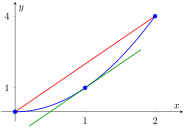
A parabola with a secant through the endpoints and a parallel tangent at an interior point.
Figure 5.3.4. For a differentiable function, some tangent line is parallel to the secant line joining the endpoints.

Example 5.3.5.

Each hypothesis in the Mean Value Theorem is necessary.
  • The function
    \begin{equation*} f(x)=\begin{cases} x & \text{if } 0 \lt x \lt 1,\\ 0 & \text{if } x=0 \text{ or } x=1 \end{cases} \end{equation*}
    is differentiable on \((0,1)\) and satisfies \(f(0)=f(1)=0\text{,}\) but it is not continuous on \([0,1]\) and there is no \(c \in (0,1)\) with \(f'(c)=0\text{.}\)
  • The function \(f(x)=|x|-1\) is continuous on \([-1,1]\) and satisfies \(f(-1)=f(1)=0\text{,}\) but it is not differentiable at \(0\) and there is no \(c \in (-1,1)\) with \(f'(c)=0\text{.}\)

Proof.

Define
\begin{equation*} h(x)=(f(x)-f(a))(g(b)-g(a))-(g(x)-g(a))(f(b)-f(a)). \end{equation*}
Then \(h\) is continuous on \([a,b]\) and differentiable on \((a,b)\text{.}\) Also \(h(a)=0=h(b)\text{.}\) By Theorem 5.3.2, there exists \(c \in (a,b)\) such that \(h'(c)=0\text{.}\) Since
\begin{equation*} h'(x)=f'(x)(g(b)-g(a))-g'(x)(f(b)-f(a)), \end{equation*}
we obtain
\begin{equation*} f'(c)(g(b)-g(a))=g'(c)(f(b)-f(a)). \end{equation*}
Taking \(g(x)=x\) in Cauchy’s theorem recovers the ordinary Mean Value Theorem. So Cauchy’s version is a genuine generalization rather than a separate result.
